The Ultimate Guide to Extinguisher Maintenance in Derby: Dos, Don’ts & Legal Checks
Get more than alarm – get peace of mind.
07881 457719
0800 233 5811
Expert Extinguisher Maintenance in Derby: Keeping Your Staff and Business Protected
Buying a fire extinguisher is the easy part. Keeping it ready for use is where many businesses slip up. An extinguisher can sit on a wall for years looking perfectly fine, yet still fail when someone reaches for it in an emergency. Poor maintenance records can also cause trouble during a fire risk assessment, an audit, or an insurance query after an incident. UK guidance is clear that fire safety equipment must be suitable, maintained, and kept in good repair.
For businesses in Derby, that matters whether you run a city-centre office, a shop, a school, a warehouse on an industrial estate, or a mixed-use premises with tenants coming and going all day. Good extinguisher maintenance is not about ticking a box. It is about making sure the right unit is in the right place, in working order, and ready to be used by trained staff if a small fire breaks out. HSE guidance also expects extinguishers to match the fire risk and for nominated people to know how to use them.
This guide explains what your team can do in-house through routine visual inspections, what they must not do, and when you need professional extinguisher maintenance in Derby to stay on the right side of BS 5306 maintenance requirements.
Extinguisher Maintenance in Derby: Monthly vs. Annual Checks
The first point to get straight is this: a monthly visual check and an annual service are not the same thing. The monthly check is a simple workplace inspection carried out by the responsible person or a member of staff acting on their behalf. BS 5306-3 says visual inspections should be carried out at least once a month, and more often where conditions justify it, such as corrosive or higher-risk environments. Government fire safety guidance also expects extinguishers to be adequately maintained and says routine checks are good practice to confirm they are still in place and undamaged.
The annual service is different. BS 5306-3 states that a basic fire extinguisher service should be carried out at least every 12 months, and that extinguishers should be maintained by a competent person. That service is part of a planned maintenance system designed to keep extinguishers safe, reliable, and fit for the hazard they are meant to cover. On top of that, some extinguisher types need deeper periodic work at longer intervals, such as five-year extended servicing for many water-based and powder units, and ten-year overhaul requirements for CO2 units.
That distinction matters for Derby fire safety compliance. Your team can and should carry out monthly fire extinguisher checks UK businesses are expected to manage internally. They cannot replace the yearly service with a quick glance and a signature in the log book.

How to Perform a Monthly Visual Inspection (Checklist)
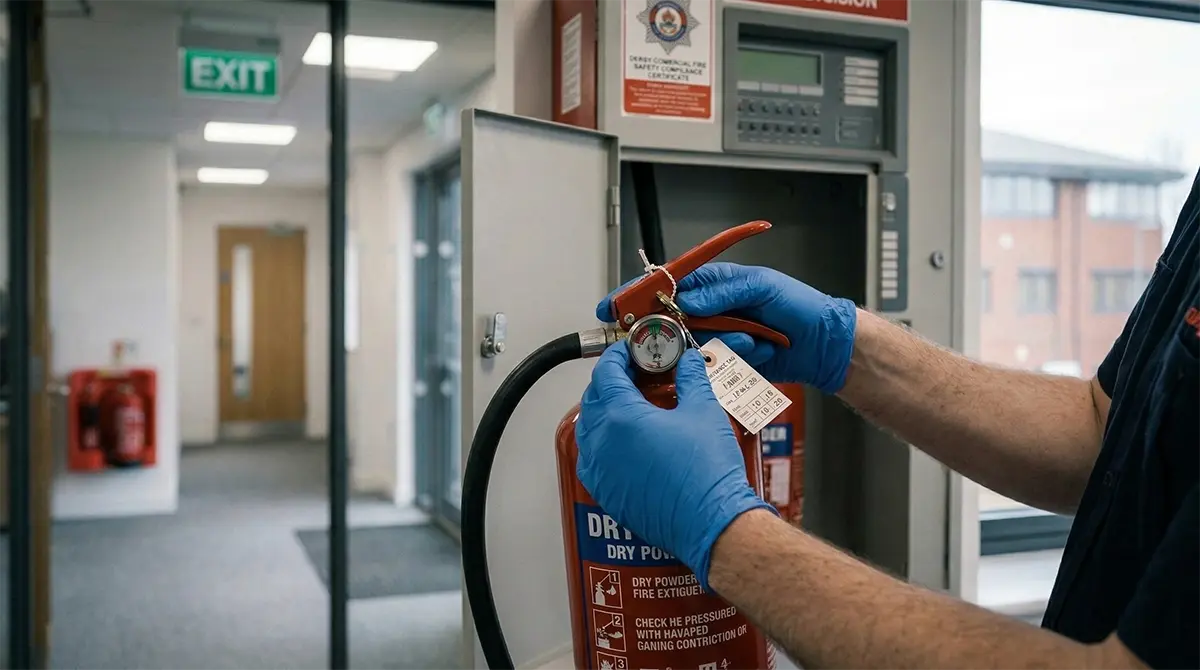
A monthly visual inspection should be quick, consistent, and recorded. It is not a technical service. You are checking for obvious signs that an extinguisher has gone missing, has been used, has been damaged, or is no longer immediately ready for use. The following checklist reflects recognised UK guidance used for routine visual inspections.
- Check that the extinguisher is in its designated location, mounted correctly on its bracket or stand, and aligned with the right sign. It should be easy to see and easy to reach.
- Make sure access is clear. If stock, cleaning equipment, furniture, or deliveries block the unit, it may as well not be there.
- Look at the label and instructions. They should be clean, readable, and facing outwards so a user can identify the extinguisher quickly.
- Inspect the safety pin and seal. If the pin is missing, the seal is broken, or the tamper indicator has gone, treat that as a problem straight away.
- Check the pressure gauge where one is fitted. The indicator should sit within the operable range. Remember that many CO2 extinguishers do not have a conventional gauge, so focus instead on signs of damage, discharge, or leakage.
- Look for signs the extinguisher has been used, even partly. Residue around the hose or horn, a disturbed seal, or obvious weight loss are all warning signs.
- Examine the body, hose, horn, nozzle, and fittings for dents, rust, corrosion, leaks, splits, clogged outlets, or missing parts.
If you find a fault, do not try to improvise a repair. Record the issue, flag it to the responsible person, and arrange for a service provider to inspect it. Where there is doubt, the responsible person should arrange for examination by a competent provider.
For busy premises in Derbyshire, that monthly walk-round is one of the simplest fire extinguisher safety tips workplace managers can adopt. It takes minutes, costs nothing, and catches the sort of small problems that later become serious ones.
Dos and Don’ts of Fire Extinguisher Care in the Workplace
Most extinguisher failures in ordinary workplaces do not start with some hidden technical defect. They start with day-to-day bad habits. A unit gets moved for decorating. A delivery gets stacked in front of it. Someone knocks off the seal and says nothing. Then months pass. A sensible routine and a few firm rules prevent most of that.
Do:
- Keep extinguishers on the proper wall bracket or stand, in the agreed position, with the correct sign above or beside them.
- Include them in a scheduled monthly inspection and note the result in your fire log book or site records. Good records help demonstrate that your fire precautions are being maintained.
- Train nominated staff in basic extinguisher awareness, including which type covers which fire risk. HSE guidance expects extinguishers to be suitable for the likely fire and nominated people to be trained in their use.
- Increase the frequency of checks if extinguishers are exposed to harsher conditions, such as workshops, loading bays, damp plant rooms, or corrosive environments.
Don’t:
- Do not let stock, bins, displays, or furniture hide an extinguisher from view or block access to it.
- Do not remove extinguishers from their set positions during cleaning, decorating, refits, or deliveries and then leave them elsewhere. The standard expectation is that they remain correctly located and visible.
- Do not tamper with the pin, seal, hose, horn, or label. A broken seal is not a minor cosmetic issue. It can mean the unit has been interfered with or partly discharged.
- Do not treat extinguishers as general objects to move around the building. Once they leave their designated place, you lose control of your cover.
Those habits matter in every sector, but they matter even more in premises with changing layouts or fast-moving stock. That is why shops, salons, restaurants, schools, workshops, landlords, and warehouse operators across Derbyshire benefit from a simple internal routine backed by professional annual servicing.

Why Your Staff Cannot Do the Annual Maintenance
This is where many business owners get caught out. A competent annual service goes beyond what staff can see on a monthly walk-round. Professional maintenance checks the extinguisher in line with BS 5306-3, confirms whether it remains safe and serviceable, and records the outcome formally. Annual basic servicing is a separate maintenance activity, and its wider purpose is to ensure extinguishers are safe, reliable, efficient, and suited to the hazard.
A trained engineer does more than look for dents. Depending on the extinguisher type, the service may involve confirming discharge has not occurred, assessing corrosion, checking labels for legibility, examining components more closely, and dealing with service actions that ordinary staff should not attempt. Longer-interval maintenance can involve discharge testing, internal examination, refilling, or overhaul work that clearly sits outside day-to-day site checks.
There is also a competence issue. The responsible person has a duty to ensure extinguishers are maintained by a competent person, and many businesses choose a suitably certified provider for that reason. In plain English, your receptionist, site supervisor, caretaker, or office manager can inspect for obvious issues. They cannot self-certify the annual maintenance and expect that to stand up as compliant servicing.
Partnering with AKSA Security for Maintenance in Derby
For firms looking for local fire extinguisher engineers Derbyshire businesses can deal with directly, AKSA Security gives you a Derby-based option with wider coverage across Derbyshire and surrounding areas including Nottingham and Sheffield. The sensible approach is to use your monthly internal checks to spot issues early, then bring in a competent provider for the annual service and any remedial work.
When comparing providers, ask what documentation you will receive, how maintenance is recorded, and how technicians are trained. AKSA Security offers the kind of practical support businesses need when they want extinguisher maintenance in Derby carried out properly, on time, and in line with legal duties and recognised standards.
Keep Your Premises Safe – Book Your Maintenance Today
If your last service date is approaching, if a recent monthly check has raised concerns, or if you cannot say with confidence when each extinguisher was last properly maintained, now is the time to act. Fire safety guidance expects extinguishers to be maintained, and a proper inspection regime should include annual servicing and clear records.
For businesses across Derby and Derbyshire, the next step is straightforward. Keep up the monthly visual checks. Deal with access and housekeeping issues immediately. Then book a competent annual service with AKSA Security so your extinguishers are ready for use, your records are in order, and your site is in a stronger position for day-to-day safety, Derby fire safety compliance, and insurer scrutiny if the worst happens.

Author: Adrian Sienkiewicz, Fire And Security Project Manager at AKSA Security
Adrian started his career as an IT Support Engineer but after a while, he moved into the security industry using his experience with IT systems. He started his first security job as a Fire and Security Engineer at ALX Security and then continued as a Fire and Security Project Manager at Bull Security.
During his career, he has worked for SECURIFIX, LASER BEAM and ZICAM GROUP as a Security Engineer, Technical Support and Operations Manager. Adrian has worked on security projects for companies such as DHL, Selco Building Warehouse and Eddie Stobart, installing anti-burglary systems, industrial surveillance and access control systems. He is working on a partnership basis with companies such as Avigilon, Motorola, Honeywell, Texecom, Hikvision, Hanwha, Dahua, Commtel, Paxton and BFT.
Adrian is a certified National Security Industry auditor.