Are You Compliant? Commercial Fire Services in Derby Explained
Get more than alarm – get peace of mind.
07881 457719
0800 233 5811
Derby Commercial Fire Services: Alarms, Extinguishers & Risk Assessments
If you run a business in Derby, fire safety is a legal duty, not an optional extra that can be dealt with later. Across England and Wales, the Regulatory Reform (Fire Safety) Order 2005 places responsibility on the person in control of commercial premises to assess fire risks, reduce those risks where possible, and make sure suitable precautions are in place. That applies to offices, warehouses, retail units, schools, workshops, hospitality venues, communal buildings and many other non-domestic properties. For any business looking for commercial fire services Derby or commercial fire protection Derby, the first question is not whether fire safety matters. It is whether your premises, systems and records would stand up to scrutiny if they were checked today.
Many businesses assume compliance means having a fire alarm on the wall and a few extinguishers near the exits. In practice, the picture is broader than that. Fire safety compliance depends on the condition of the system, the quality of maintenance, the accuracy of the fire risk assessment, the suitability of equipment for the building, and the ability of staff to respond properly if an incident occurs. A neglected system can create a false sense of security. A well maintained one gives you a far better chance of protecting people, property and business continuity.
What Are Commercial Fire Services?
Commercial fire services cover the inspection, installation, servicing and practical support that help businesses manage fire risk properly. These services are designed for commercial premises rather than private homes, so they take into account issues such as staff numbers, public access, stock, machinery, emergency routes, legal duties and maintenance records. In simple terms, they are the services that help a business reduce the chance of a fire starting, detect a fire quickly if one does occur, and support safe evacuation.
- Fire Risk Assessments
- Alarm Installation and Servicing
- Extinguisher Maintenance
- Emergency Lighting
A fire risk assessment usually sits at the centre of everything else. It looks at the building, the hazards present, the people who may be at risk, and the measures needed to make the premises safer. From there, decisions can be made about the type of alarm system required, the best detector locations, whether emergency lighting is adequate, and how extinguishers should be positioned. Without that foundation, a business can end up spending money on equipment that does not properly match the risks on site.
Alarm installation and servicing are equally important. A fire alarm system has one job – to raise the warning quickly and clearly. That sounds simple, but the right setup depends on the building layout, the use of the space, the escape routes and the category of protection needed. Extinguisher maintenance also plays a practical role. Extinguishers must be suitable for the risks present and kept in good working order. Emergency lighting is another part of the same picture. If the power fails during an incident, people still need to see escape routes clearly enough to leave the building safely.
Fire Safety Compliance in Derby: What You Need to Know
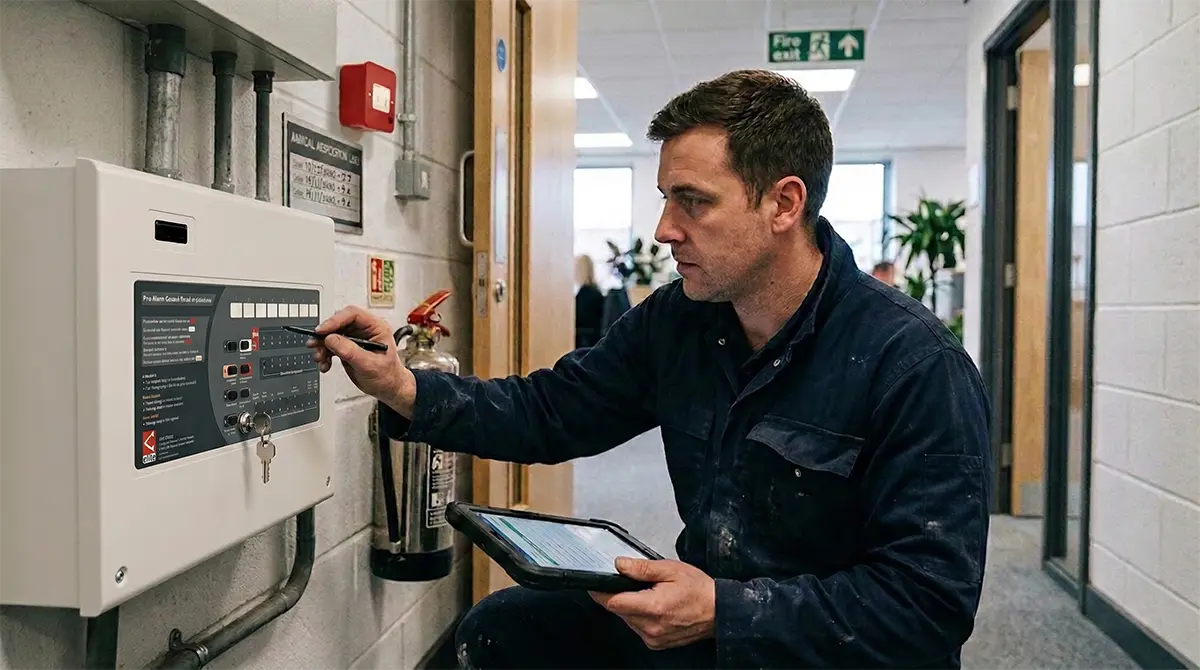
For businesses in Derby, compliance starts with understanding who holds responsibility. In most cases, that will be the employer, owner, landlord, managing agent or another person with control over the premises. The law expects that person to identify risks, act on findings and keep fire precautions under review. This is not a one-off exercise. A fire risk assessment should reflect the building as it is now, not as it was two or three years ago. If the layout changes, occupancy increases, stock levels rise, machinery is added or the use of rooms changes, the assessment may need updating.
That matters because many commercial buildings evolve over time. A storage room becomes an office. A meeting room turns into a server room. A retail unit adds more display fixtures and reduces open circulation space. A workshop starts using different materials. Each change can affect escape routes, ignition risks, detector coverage or the suitability of extinguishers. Fire safety compliance is strongest when those changes are reviewed properly rather than left to chance.
Derbyshire businesses should also be aware of the role of Derbyshire Fire & Rescue Service. Local enforcement and guidance matter. A business does not need to wait for an inspection or complaint before reviewing its arrangements. The sensible approach is to keep records current, carry out servicing on time, train staff appropriately and make sure the building still meets the needs of the people using it. That is especially important in properties with higher occupancy, sleeping areas, public access or complex layouts.
The risks of poor compliance go beyond the possibility of enforcement action. If a fire occurs and maintenance records are missing, alarm servicing has lapsed, or the fire risk assessment is clearly outdated, the consequences can spread quickly. You may face disruption to trading, costly repairs, damaged reputation and difficult conversations with insurers. In some cases, insurance claims can become more complicated if basic responsibilities have been neglected. Even where the building avoids serious damage, an unreliable alarm system or poor fire precautions can lead to unnecessary evacuation problems, repeated false alarms and avoidable downtime.
How Often Do Derby Businesses Need Fire Alarm Servicing?
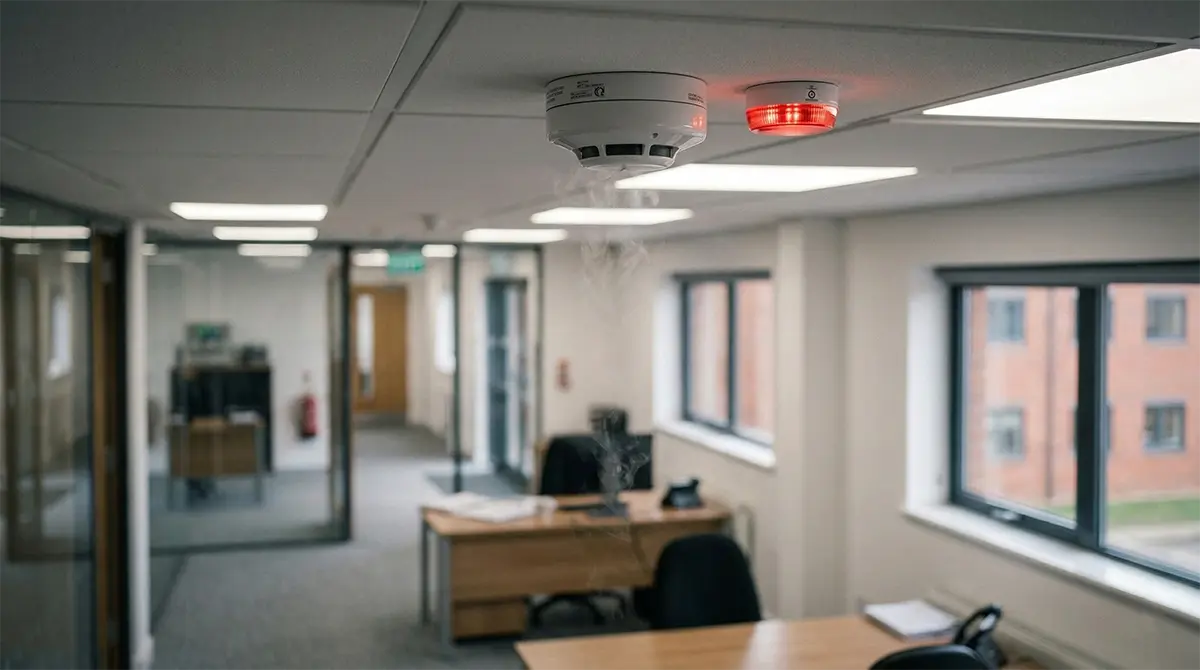
One of the most common questions from business owners and facilities managers is simple: how often do commercial fire alarms need servicing in the UK? In many commercial premises, the standard expectation is that the system should be inspected and serviced by a competent engineer every six months. That timetable is widely recognised under BS 5839 and is often the minimum benchmark businesses work to. Depending on the building, the fire risk assessment and the type of system installed, some premises may need a more frequent maintenance schedule.
That six-month service interval should not be confused with the routine checks that happen in between. Day to day and week to week, staff may still need to carry out basic checks, such as confirming the panel shows normal operation, recording faults, monitoring false alarms and making sure obvious issues are reported quickly. A professionally serviced system and sensible in-house checks work together. One cannot fully replace the other.
Proper servicing involves far more than pressing a test button and listening for the sounders. A competent engineer should inspect the control panel, power supply, batteries, detectors, call points, sounders and fault history. They should also look at whether the building has changed since the system was installed. A detector that once covered a clear area may no longer be in the right place after a partition wall has been added. A stockroom may have become more heavily loaded. Dust, fumes or steam may be causing repeated false alarms. A good maintenance visit should identify those issues before they become expensive or dangerous.
This is why fire alarm maintenance Derbyshire businesses rely on should never be treated as a casual admin task. Missed service visits often lead to rushed last-minute bookings before audits, surveys or insurance reviews. That is when faults tend to surface at the worst possible time. Planned maintenance gives a business control. It reduces the chance of unexpected failures and keeps the system aligned with the way the premises are actually being used.
The same principle applies to extinguishers and emergency lighting. If extinguishers are present but overdue for service, incorrectly located or no longer suitable for the risks on site, their value drops sharply. Emergency lighting that has not been checked properly may fail just when it is most needed. Fire safety works best when these areas are looked at together rather than as separate jobs handled only when someone notices a sticker date has passed.

Why Choose a Local Fire Protection Company in Derby?
There is a practical advantage in working with a company that knows Derby and the wider Derbyshire area. Response times are usually better. Site visits are easier to arrange. Engineers are more likely to understand the range of commercial premises found locally, from industrial units and schools to offices, shops, apartment blocks and converted mixed-use buildings. A local company can usually offer a more direct service, especially when a business needs urgent fault finding, a survey before works begin, or support after repeated alarm issues.
That local knowledge also helps when the job is not straightforward. Many commercial properties have awkward layouts, phased extensions, changed room use or older parts of the building that do not match original drawings. In those cases, experience on site matters more than a generic quote produced from a distance. Businesses searching for the best commercial fire alarm company in Derby are often looking for reliability, clarity and realistic advice rather than a sales pitch. They want to know what is required, what can wait, what standard applies and how the system should be maintained going forward.
Choosing a local provider based in Derby, like AKSA Security, also makes sense when continuity matters. It is far easier to manage compliance when the same company can assess the premises, install or upgrade the system, carry out ongoing maintenance and respond when faults appear. Records stay together. Recommendations are easier to follow. Small concerns are less likely to be forgotten between different contractors. For a busy business owner or site manager, that joined-up approach is often the difference between organised compliance and constant catch-up.
How AKSA Security Can Protect Your Business
AKSA Security provides commercial fire services for businesses in Derby and the surrounding area. That includes support for companies that need a fresh fire risk assessment, an upgrade to an older alarm system, regular maintenance, fault diagnosis or routine fire extinguisher servicing. The aim is not simply to fit equipment and leave. It is to help commercial premises stay protected and properly maintained over time.
- Fire risk assessments for commercial premises
- Commercial fire alarm installation
- Fire alarm maintenance and repair
- Guidance aligned with BS 5839
- Fire extinguisher servicing
That range of services matters because most buildings do not stay static. A company may expand into the next unit, reconfigure office space, increase storage capacity or change the way part of the premises is used. When that happens, fire protection arrangements often need attention as well. A system that was suitable three years ago may no longer reflect the current risks. Working with a provider that understands the building, the maintenance history and the wider compliance picture makes those decisions simpler and more accurate.

Protect Your Premises Before a Fault Becomes a Fire Safety Problem
The strongest fire safety arrangements are rarely the result of a last-minute rush. They come from regular review, clear records, sensible maintenance and decisions based on the real conditions inside the building. Businesses that stay on top of compliance usually know when their next service is due, where their risk assessment is stored and what changes have taken place since it was last reviewed. They do not wait for a fault, a near miss or an inspection letter to start asking questions.
If your business premises in Derby need a clearer fire safety plan, overdue maintenance, a system review or a fresh fire risk assessment, AKSA Security can help you take the next step. Do not leave your commercial premises exposed to avoidable risk. Contact AKSA Security today for practical advice on commercial fire protection in Derby and across Derbyshire, and speak to a local team that understands what your business needs.

Author: Adrian Sienkiewicz, Fire And Security Project Manager at AKSA Security
Adrian started his career as an IT Support Engineer but after a while, he moved into the security industry using his experience with IT systems. He started his first security job as a Fire and Security Engineer at ALX Security and then continued as a Fire and Security Project Manager at Bull Security.
During his career, he has worked for SECURIFIX, LASER BEAM and ZICAM GROUP as a Security Engineer, Technical Support and Operations Manager. Adrian has worked on security projects for companies such as DHL, Selco Building Warehouse and Eddie Stobart, installing anti-burglary systems, industrial surveillance and access control systems. He is working on a partnership basis with companies such as Avigilon, Motorola, Honeywell, Texecom, Hikvision, Hanwha, Dahua, Commtel, Paxton and BFT.
Adrian is a certified National Security Industry auditor.