Festive-season fire risks: how to keep your fire alarm system ready in December and over Christmas shutdowns
Get more than alarm – get peace of mind.
07881 457719
0800 233 5811
Festive-season fire risks
December changes how buildings behave. Kitchens run longer, heaters appear under desks, deliveries stack up in lobbies, and communal areas collect extra combustibles in the name of seasonal décor. At the same time, routines slip. Keyholders take leave, contractors push to finish year-end jobs, and that quiet little phrase – ‘we’ll deal with it in January’ – starts to sound like a plan. Fire alarm systems don’t care about calendars, though. A small fault that felt manageable in November can turn into an out-of-hours call-out when the building is empty, and the one person who knows the panel is away.
There’s also a hard seasonal pattern behind the gut feeling many facilities teams already have. NFCC commentary, drawing on Home Office figures, has highlighted a consistent bump in England: people are 10% more likely to have an accidental home fire in December than in other months, and Christmas Day is markedly worse, with NFCC citing a 53% higher likelihood of a fire compared with an average day.
Those numbers focus on homes, but the same seasonal pressures show up in workplaces and multi-occupied buildings: more cooking and events, more temporary electrics, and fewer people around to spot early warning signs.
If you’re searching for Christmas fire safety UK, December fire risk, or fire alarm shutdown checks, the most useful answer isn’t generic advice. It’s a practical, seasonal routine: check the system’s health, control the changes you’re making to the building, plan who responds out of hours, and document the checks so you can show what you did and why.
Why December risk is higher
The festive season doesn’t invent new risks. It adds load to existing ones and makes people more likely to miss early warning signs. Cooking is the obvious example. Bigger meals mean longer cooking times, more ovens on, more hob use, and more people moving through a kitchen. In domestic settings, that’s when smoke alarms get silenced because nobody wants noise during “just one more thing”. In commercial premises, it shows up differently: propped-open kitchen doors, extraction left off to keep heat in, or detectors that start giving nuisance alarms because the air in the space changes for a few weeks.
Electricity runs a close second. Decorative lights, pop-up displays, extra chargers, and temporary heaters compete for sockets that were never designed for that demand. Walk into a site in Derby, Nottingham or Sheffield in early December and you’ll often spot the familiar setup: adaptors stacked behind a tree, one extension lead feeding half a room, or a heater sharing a power strip with a kettle and a microwave. Most of the time nothing happens. Until it does. Electrical faults also have a habit of starting quietly – a warm plug, a damaged cable, a loose connection – and turning into something bigger when the building is unattended.
Then you have the building-management side. Deliveries and storage creep into routes that should stay clear. Fire doors get wedged because staff want easy movement during busy periods. Contractors isolate devices during testing and forget to re-enable them. Someone silences a sounder circuit for a ‘quick job’ and never comes back to finish the job properly. Reduced staffing means fewer eyes on the fire alarm panel, fewer people hearing fault beeps, and fewer chances to catch small issues while they are still small.
All of that sits on top of the simple truth about shutdowns: when a building is empty, you rely more heavily on the fire alarm system, on monitoring arrangements, and on keyholders. If any one of those parts is weak, you can end up with a fault condition for days, a disabled zone that nobody remembers, or a repeat false alarm pattern that trains people to ignore signals.

Pre-holiday fire alarm health check
A December ‘health check’ works best when it builds on your normal routine rather than replacing it. Most non-domestic premises already run user tests and keep a service/maintenance programme in place. The pre-holiday focus is simple: confirm the system is healthy, confirm it has power resilience, confirm the right people can respond, and record what you did so you can evidence control.
Weekly test discipline that actually helps
Weekly user testing sounds basic, but it’s one of the quickest ways to spot system drift, and UK guidance commonly references weekly testing as good practice in many premises.
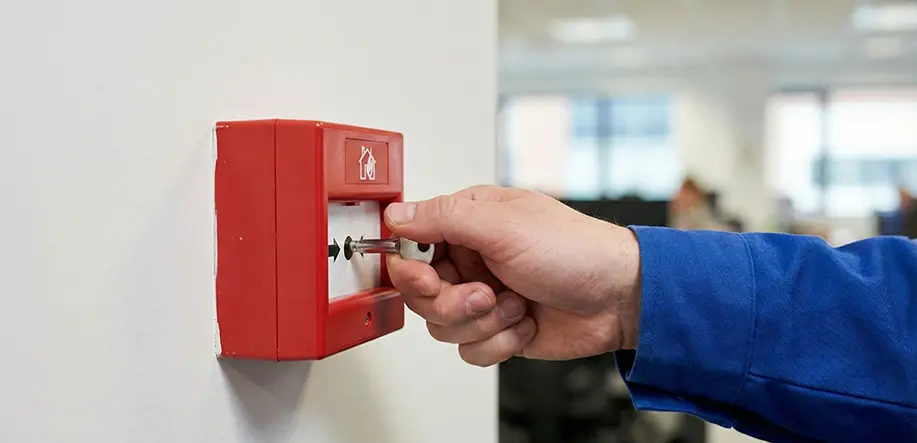
In December, consistency matters. Choose a time when staff are present, do the test at roughly the same time each week, and make sure the building understands what a test sounds like. Rotate the manual call point you operate so you build coverage over time, and write down which device you used and whether sounders and visual indicators were clearly heard/seen in the expected areas. That small discipline pays off in December because it tends to catch the “quiet failures”: a sounder circuit that has been silenced, a partial coverage problem at the far end of the building, or a device that has been damaged by routine activity.
During the weekly test, listen properly. Don’t just confirm ‘it made a noise’. Walk an area that often sits at the edge of audibility, such as a storeroom, a back office, a toilet block, a plant corridor or a quiet stair. In older buildings, sound levels vary widely between rooms, and seasonal displays can change acoustics in surprising ways. If someone muted a sounder, or a circuit has a fault, you often notice it on a quiet test day rather than during a busy trading day.
Panel status, disablements, and the messages people ignore
Before you close for Christmas, stand in front of the control panel and read it as if you’ve never seen it before. Any fault condition, disablement, test mode, power supply issue, battery indication, or device isolation needs a reason and a fix. If the reason is ‘we always have that fault’, treat that as a warning sign. A persistent fault is still a fault, and the festive season is when it tends to turn into an emergency because there are fewer people around to notice the deterioration.
Disablements deserve extra attention in December because they often happen for understandable reasons: contractors working in a ceiling void, a dusty refurbishment, an office party with smoke effects, or a temporary change in use of a space. The problem starts when the disablement outlives the reason. Keep control with a simple habit: write down what is disabled, why it is disabled, who authorised it, what temporary measures apply while it remains disabled, and the time it must be re-enabled. If you can’t answer those questions quickly, you don’t have control of the risk — and shutdown is exactly when that lack of control gets exposed.
Standby power and batteries: deal with it before the weather does
A fire alarm system should keep operating during a mains failure. That’s why it has standby batteries. Around Christmas, power interruptions become more common: winter weather, year-end electrical work, and older premises running heaters and seasonal loads. If your panel shows battery or charger faults, deal with them before you shut the doors. If you don’t know the age of the batteries, find out and plan replacement when appropriate. Batteries don’t fail politely on a convenient day; they fail when they have had enough, and a “fault for weeks” situation is exactly the sort of thing that becomes a bigger problem when the building is closed.
If your system connects to monitoring, include the signalling path in your pre-holiday routine. You want confidence that a genuine activation will reach the right place and that a communication fault will be noticed. Monitoring arrangements usually rely on an up-to-date keyholder list, so update contact details in early December rather than waiting until the final days before Christmas when half the list is already away and you’re trying to chase people for numbers.
Simple housekeeping around detection
Seasonal changes in the environment can trigger nuisance alarms. Dust from loft decorations, aerosols from sprays, steam from catering, and heat from temporary heaters can all affect detection depending on the device type and its location. Don’t start cleaning detectors with the nearest product on the cleaning trolley. That can cause damage. If you have a competent maintenance provider, schedule a targeted check in higher-risk areas, especially where you know the festive season changes how the space is used. It’s usually cheaper to manage this proactively than to pay for repeat out-of-hours attendance because a single detector has become hypersensitive in a changed environment.
A practical approach is to walk the building and ask one question in each space: what changed near the detectors since November? New decorations, new displays, stacked stock, a new heater, a relocated coffee machine, or a catering setup for staff events can change airflow and particle levels. Those small changes explain a lot of the ‘mystery’ false alarms that happen in December, especially early morning when heating systems ramp up and air moves differently through a building.
Verify the call-out chain, access, and decision-making
Shutdown breaks contact chains. The caretaker who normally attends alarms might be away. The facilities manager might be out of the country. Security might be working reduced hours. If an alarm activates, who attends, how quickly can they get in, and who has authority to act? Who knows where the panel is, who has the code, and who can authorise an engineer? Write it down, then test it in a low-stakes way: make a couple of calls to confirm people answer, confirm keys exist and are where you think they are, and confirm that the person taking responsibility understands what they are taking on. The first time someone tries to work out how to silence and reset an alarm panel shouldn’t be at 3 am on Boxing Day.
Decorations and temporary electrics – keeping within limits and avoiding detectors’ nuisance triggers
Seasonal décor and temporary electrics usually arrive with good intentions and messy execution. The safe approach isn’t joyless; it’s organised. Place decorations so they don’t introduce ignition sources, don’t interfere with fire detection, and don’t block escape routes, call points, extinguishers, or fire doors.
A Christmas tree – real or artificial – is a combustible load in the middle of a room. Add paper chains, wrapping, cardboard displays, and table coverings and you have plenty of fuel. The issue isn’t that these items exist; it’s the distance to heat sources and the way people place them without thinking. Keep decorations well away from portable heaters, radiators, spotlights, kitchen equipment, and any electrical items that run warm. In offices, a heater under a desk can easily end up behind a display or near a pile of cardboard packaging. In retail, a display can migrate closer to lighting as the shop floor changes. In schools, corridors can fill with craft items and paper displays at exactly the time of year when occupancy patterns shift for concerts and events.
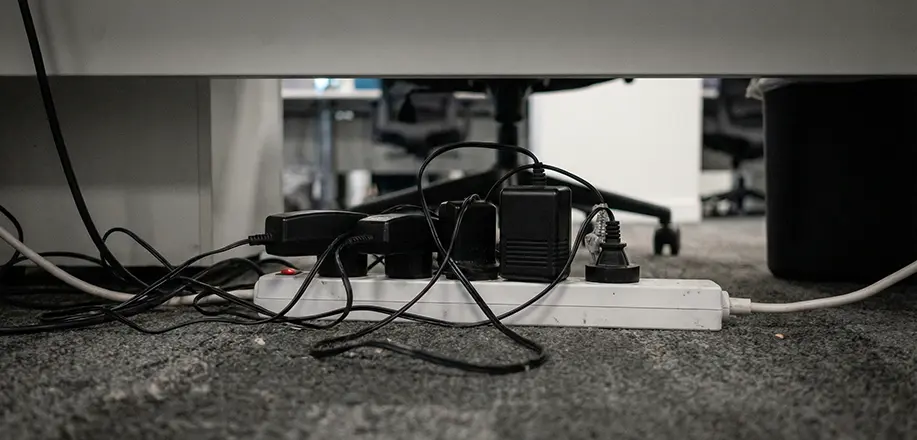
Temporary electrics cause trouble when people treat them as permanent. Remove the ‘one more adaptor’ habit early. Plug one extension lead into one socket, then use it within its rating. Avoid daisy-chaining extensions. Don’t stack adaptors. Don’t run cables under rugs or across escape routes where they become trip hazards. If you find yourself building the same temporary setup every year, it’s often more sensible to plan a permanent electrical improvement than to keep improvising. Those improvised setups also create hard-to-trace faults: intermittent power, warm plugs, and damaged cables hidden behind décor where nobody looks until something fails.
Decorative lighting deserves a quick inspection before use. Check the cable for damage, check the plug, and avoid using damaged or very old sets. Switch decorative lighting off when areas are unattended. In workplaces that close for Christmas, consider whether the simplest answer is to unplug non-essential seasonal electrics entirely during shutdown, especially in storerooms, back offices and communal lounges where nobody would notice a developing issue quickly.
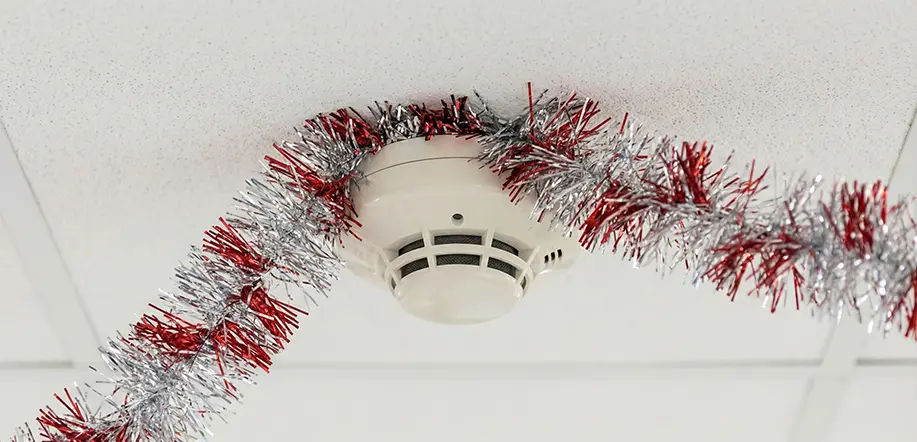
Decorations can interfere with detection in subtle ways. Hanging items can channel warm air into smoke detectors and create nuisance triggers. Paper and fabrics can trap dust. Aerosol ‘snow’ sprays can put particles into the air that look like smoke to optical detectors. Haze machines at parties can do the same on a larger scale. The best control is planning. If your site runs events and you know you’ll use haze or effects, speak to your fire alarm provider in advance. A managed plan might involve narrowly-scoped, time-bound isolations with agreed temporary measures and strict re-enablement. A bad plan is someone pressing buttons on the panel five minutes before an event and hoping they remember to reverse it at midnight.
Staffing changes and shutdowns – who’s the ‘Responsible Person’, who attends the panel, and how to keep the site monitored
In the UK, the idea of the ‘Responsible Person’ sits at the centre of fire safety management for many non-domestic premises. The Regulatory Reform (Fire Safety) Order 2005 describes who that person is in broad terms: usually the employer, the person in control of the premises, or in some cases the owner.
December doesn’t change those duties. It exposes weak handovers and vague arrangements.
When the building is occupied, gaps get covered by chance. Someone hears a fault beep and tells the caretaker. Someone notices a door wedged open and removes the wedge. During a shutdown, you rely on systems and planning rather than chance. That means you need two things: attendance and decision-making. Attendance means someone can get to site quickly, access relevant areas safely, read the panel and investigate without taking risks. Decision-making means someone can authorise call-outs, liaise with monitoring services, and decide whether the building can reopen or needs restrictions after repeated activations.
Many sites think they have this covered because they have a list of names. Lists are fragile. Phones change. People go away. If your plan relies on one person, you have a single point of failure. Build in redundancy that matches the site: two keyholders minimum, more where premises are large, higher risk, or complex. Make sure those keyholders have access and a basic understanding of what ‘normal’ looks like on the panel. If they have never used the panel, the week before Christmas is the time for a short, practical walk-through, not the time for them to learn under pressure.
Monitoring arrangements deserve a plain-English check. If your system is monitored, confirm what happens on an alarm and what happens on a fault. NFCC has produced guidance around unwanted fire signals and how monitoring practice affects response.
In practical terms, you want to know how calls get made, who gets contacted first, what happens if nobody answers, and whether the alarm receiving centre has your closure dates and up-to-date contact order. That stops wasted calls to an office phone nobody will answer for ten days.
Contractors add another layer of risk because December is popular for works. Isolations happen ‘just for the afternoon’ and remain in place for days. Control this with routine rather than drama. If a contractor needs an isolation, require a written record stating what is isolated, why it is isolated, the start and end time, and who signs off re-enablement. Tie that record to your fire logbook and follow up. The simple act of requiring a signature and a time limit prevents a lot of ‘forgotten’ disablements, which are exactly the kind of thing that can undermine your system during a shutdown.
Multi-occupied residential buildings and HMOs need an extra level of clarity because occupants respond differently when they feel repeated alarms are ‘probably nothing’. Common parts create shared disruption, and repeated activations at 2 am can create risky behaviours such as residents ignoring alarms. Communication helps. Make sure residents know what the alarm sounds like, what they should do, and how they report faults. If you rely on a managing agent, confirm who is on duty through the festive period. If you manage a mixed-use building, pay attention to the interface between occupancies because Christmas trading changes the risk profile at ground level while residents still need safe escape routes above.
False alarm reduction tips for the festive period and logging near-misses
False alarms waste time and, over the long run, they slow response because people stop taking signals seriously. They can also bring unwanted attention if a premise shows little improvement over time. Fire and rescue services publish information about unwanted fire signals and the expectation that organisations manage them, and Derbyshire Fire and Rescue Service is one example of an authority that makes clear it expects businesses to address repeated unwanted signals.
NFCC also has specific guidance aimed at reducing unwanted fire signals and improving monitoring practice.
December is a prime time for unwanted signals because buildings change for a few weeks, then try to pretend nothing changed.
Catering is the most common seasonal trigger. Christmas functions generate more steam, more cooking aerosols, and more grease than usual. If you have smoke detection too close to cooking or washing-up areas, nuisance activations become likely. Basic operational controls matter more in December because the volume of cooking increases: use extraction properly, keep kitchen doors closed where appropriate so steam doesn’t drift into adjacent detector areas, and keep to designated cooking locations. Some fire services give direct examples of these causes and controls, including the role of extractor fans and separating cooking areas from detectors.
If a premise sees repeat activations, treat it as a technical and behavioural issue: check the detection type and location, but also check whether staff routines changed for the season.
Party effects come next. Haze and fog can trigger optical detectors easily. Aerosol ‘snow’ sprays and heavy use of cleaning sprays near detectors can cause similar problems. Reduce risk by controlling what is allowed, briefing staff and event organisers, and setting rules that are easy to enforce: no haze without permission, no sprays near detectors, and no covering or tampering with devices. If you choose to isolate any part of the system during an event, keep it narrow, time-bound, authorised and documented, then confirm re-enablement and normal status immediately afterwards. People forget. Your process should make forgetting harder.
Portable heaters can create their own seasonal pattern of unwanted signals by changing airflow and temperature at ceiling level. In a small room, a heater placed directly under a detector can create a local plume that changes the environment enough to cause trouble, especially when heating cycles on early in the morning. Placement is the simple control: keep heaters away from detectors and combustible materials, and avoid corners where hot air collects. If staff bring personal heaters in, treat it as a policy issue with a clear rule and a clear reason, because December is the month when ‘little extras’ multiply.
The logbook is where you turn all of this into control rather than anecdotes. A useful entry isn’t ‘false alarm, reset’. A useful entry captures the date and time, the device or zone, what was happening, the likely cause, what action you took, whether you contacted an engineer, and what you will change to prevent a repeat. This level of detail turns a string of annoying activations into a pattern you can fix. It also makes maintenance visits more efficient because the engineer arrives with context and can go straight to the likely source, rather than testing blind.
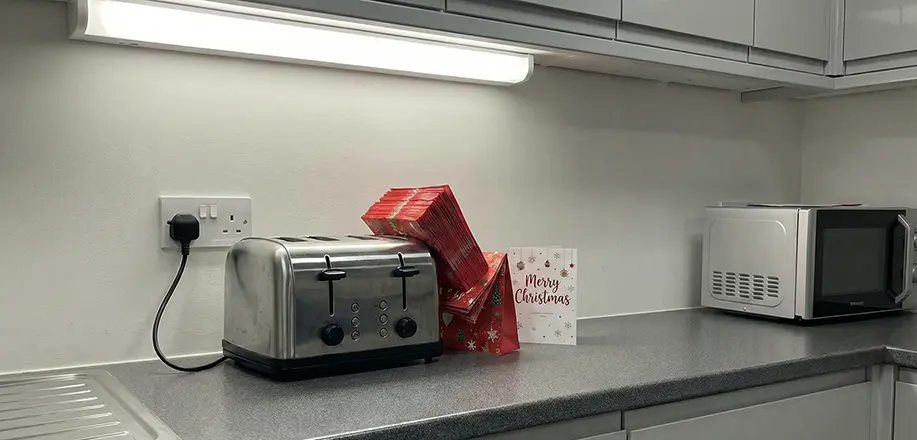
Near-misses belong in the log too. If a smoke detector triggers whenever the staff toaster runs, that’s a near-miss until it becomes a call-out. If a corridor becomes partially blocked by seasonal deliveries, that’s a near-miss. Writing it down forces the issue into the open, which makes it easier to solve before the building closes.
Quick landlord notes (PRS/Social): smoke/CO duties and reset after activations
Landlords and managing agents often see a December spike in tenant contact: chirping alarms, nuisance activations, and questions about what to do after an incident. Clear processes save time, especially if you manage multiple properties across Derbyshire, Nottinghamshire and South Yorkshire.
In England, the Smoke and Carbon Monoxide Alarm (England) Regulations 2015, as amended in 2022, set duties to provide smoke alarms on every storey of a rented home and carbon monoxide alarms in rooms with fixed combustion appliances, with the scope and detail set out in the legislation and government guidance.
The amendment introduced a duty for landlords to repair or replace alarms once informed they are faulty, within the expectations described in the guidance.
In real December terms, that means you need an easy way for tenants to report faults and a planned route to respond when cover is reduced. Keep basic records per property: what alarms are installed, where they are located, whether they are mains or battery, and the installation date if known. When a tenant reports a fault, you can act quickly rather than starting from scratch. It also helps you spot patterns, such as a particular model reaching end-of-life across several properties at the same time, which is common in portfolios where alarms were installed in batches.
After activations, tenants often silence a device and leave it in a half-reset state. This is common with domestic alarms that latch into alarm mode or that show a fault beep after heavy cooking smoke. Your process should include a check that the device returns to normal operation and that any end-of-life warnings get addressed rather than ignored. In HMOs with communal systems, repeated activations can create risky behaviour, so quick fault-finding and targeted maintenance matter more during the festive period than at quieter times of year.
For larger portfolios, Christmas shutdowns can complicate repair programmes. Build a short seasonal service window into early December where you prioritise known issues: alarms at end-of-life, repeat activations, and properties with reported defects. That approach reduces emergency call-outs later, makes it easier to keep tenants informed, and protects your own time when the holiday period is already busy.
Derby/East Midlands: rapid call-outs and seasonal service windows
Seasonal fire alarm readiness is partly technical and partly logistical. The technical part is making sure the system works: devices, sounders, power supply, signalling, and the cause-and-effect strategy. The logistical part is ensuring someone responds, can get access, and can take action when the building is quiet. In Derby, Nottingham and Sheffield, that logistical piece often trips people up over Christmas because the region has a mix of older city properties, converted buildings, multi-let premises, schools, offices, warehouses and mixed-use sites where the way a building is used changes sharply in December.
A realistic December timeline helps. Work backwards from your closure date. Two to three weeks before shutdown, you can still book planned servicing, complete parts replacements, and deal with outstanding faults without rushing. In the final week before Christmas, you can still complete user checks and confirm contacts, but you have less room to manoeuvre if your system needs new batteries, a device replacement, or remedial work on wiring, sounders or signalling. If you’re searching for Derby fire alarm maintenance or planning fire alarm shutdown checks in Nottingham or Sheffield, earlier is almost always easier.
We see the same festive call-out patterns every year across the East Midlands and South Yorkshire. Fault beeps ignored for weeks become a panel locked into fault. Batteries close to end of life fail during a brief mains interruption. Contractors isolate a zone and forget. A detector in a staff kitchen triggers repeatedly because of cooking aerosols and poor ventilation. A sounder circuit fails and nobody notices until a weekly test reveals weak coverage. None of these issues are dramatic. They’re routine, which is exactly why a short, well-timed December check prevents so many of them.
AKSA Security supports businesses, landlords and managing agents with fire alarm maintenance, servicing and fault-finding across Derby, Nottingham, Sheffield and the surrounding areas. If you want to reduce the chance of a Christmas shutdown emergency, the most effective step usually comes down to timing: bring forward the work you already know you need, then close the building with a clean panel, an up-to-date keyholder chain, and records that show exactly what you checked.

Author: Adrian Sienkiewicz, Fire And Security Project Manager at AKSA Security
Adrian started his career as an IT Support Engineer but after a while, he moved into the security industry using his experience with IT systems. He started his first security job as a Fire and Security Engineer at ALX Security and then continued as a Fire and Security Project Manager at Bull Security.
During his career, he has worked for SECURIFIX, LASER BEAM and ZICAM GROUP as a Security Engineer, Technical Support and Operations Manager. Adrian has worked on security projects for companies such as DHL, Selco Building Warehouse and Eddie Stobart, installing anti-burglary systems, industrial surveillance and access control systems. He is working on a partnership basis with companies such as Avigilon, Motorola, Honeywell, Texecom, Hikvision, Hanwha, Dahua, Commtel, Paxton and BFT.
Adrian is a certified National Security Industry auditor.