The Derby Business Guide to Commercial Fire Alarm Maintenance & BS 5839
Get more than alarm – get peace of mind.
07881 457719
0800 233 5811
Protect Your Premises: Reliable Commercial Fire Alarm Maintenance in Derby
A working fire alarm sits on the line between a manageable incident and a full-scale business emergency. For many owners and facilities managers in Derby, the system only gets real attention when it starts beeping, shows a fault, or sends everyone into the car park for no good reason. That is usually the point when people discover that installation was only the start. Ongoing maintenance is what keeps the system lawful, dependable and ready when the building needs it.
If you are looking for commercial fire alarm maintenance Derby, the first thing to get clear is this: the law does not stop at having an alarm on the wall. The Responsible Person must make sure fire safety equipment is maintained, records are available, and the system remains fit for purpose. In practice, that means regular user checks, proper logbook entries, and planned engineer servicing to BS 5839 standards.
Commercial Fire Alarm Laws in the UK (BS 5839)
In England and Wales, the main law is the Regulatory Reform (Fire Safety) Order 2005. It applies to workplaces and places legal duties on the Responsible Person, usually the employer, owner, landlord or managing agent, to carry out a fire risk assessment and put in place and maintain general fire precautions. The law also says fire safety equipment must be subject to a suitable system of maintenance and kept in efficient working order and good repair. Enforcement authorities can inspect records of testing and maintenance, and failures can lead to notices, prosecution and criminal sanctions.
That is where BS 5839-1 comes in. It is the recognised UK code of practice for fire detection and fire alarm systems in non-domestic premises, and it is widely used as the benchmark for accepted good practice. For business owners in Derby, the message is straightforward. Your system needs planned inspection, servicing, proper documentation and competent maintenance support. A fire alarm should never be treated as a fit-and-forget system.
This matters in every type of commercial setting across Derby and Derbyshire. Offices, shops, schools, warehouses, apartment blocks and mixed-use properties all have different fire risks, different evacuation arrangements and different operating patterns. A compliant maintenance regime needs to reflect how the building is actually used, not just what was written on the original installation paperwork years ago.

Weekly Testing vs. Professional Maintenance: What’s the Difference?
This is where many businesses get caught out. A weekly test and a maintenance visit are not the same job, and one does not replace the other. Weekly testing is a quick user check. Professional servicing is a technical inspection carried out by a competent engineer. If those two duties get mixed together, important gaps appear very quickly.
A proper weekly fire alarm test is usually carried out by a member of staff on site. The aim is simple. You confirm that the system can still raise the alarm and that staff know the process. In most premises, that means activating a different manual call point each week, checking that the alarm sounds correctly, confirming any linked devices respond as expected, and recording the result in the weekly fire alarm testing logbook. If the system is monitored remotely, the alarm receiving centre should be informed before and after the test to avoid an unnecessary call-out.
That weekly test is useful, but it has limits. It does not tell you whether detectors are becoming contaminated, whether standby batteries are weakening, whether interfaces are operating within tolerance, or whether recurring faults are building up in the background. It gives a snapshot. It does not amount to full maintenance.
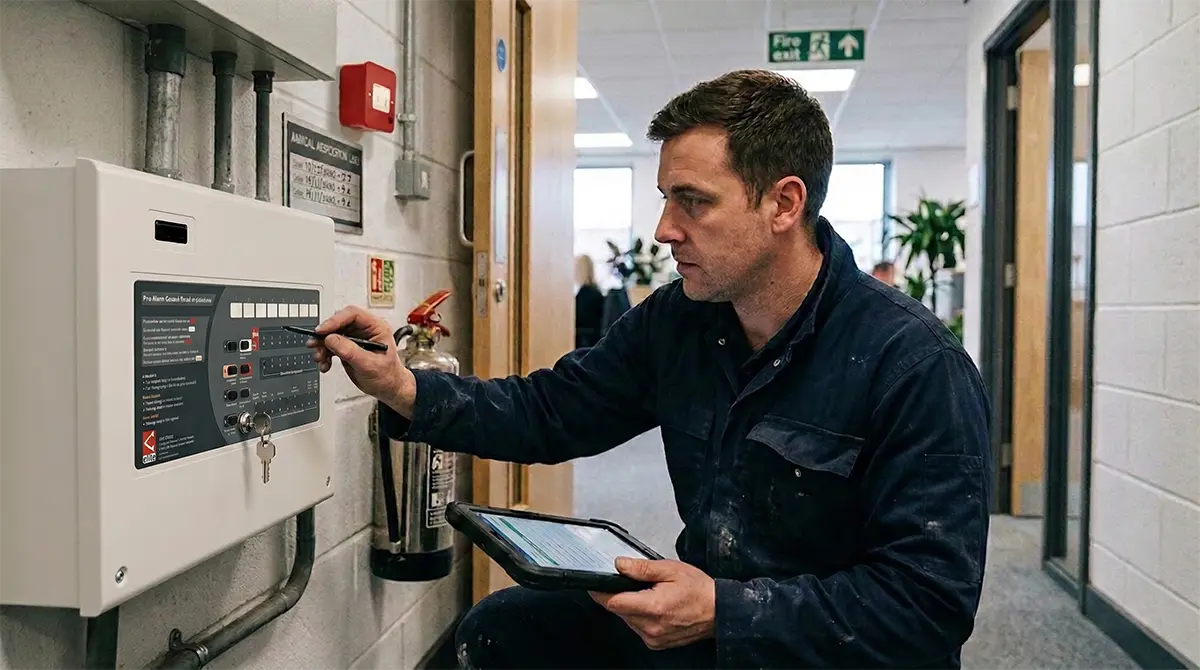
Professional servicing is different. Under BS 5839 fire alarm servicing UK guidance, a competent engineer should inspect and service the system at regular intervals, with six months being the normal maximum gap between visits for most commercial premises. During that visit, the engineer carries out a structured inspection of the panel, devices, power supplies, fault history, sounders, interfaces and records. Detectors and manual call points are tested properly. Standby batteries are checked. Any faults, isolation issues or false alarm patterns are investigated.
A true 6-monthly fire alarm inspection Derby businesses can rely on should leave the site with more than a signature on a sheet. It should leave a clear service record, a list of faults or recommendations where relevant, and a proper picture of the system’s condition. That is the difference between proving the alarm rings and proving the fire alarm system is being maintained as a life-safety system.

The Hidden Cost of False Alarms for Derby Businesses
False alarms are where poor maintenance turns into a business problem. A system that is not looked after properly is far more likely to trigger unwanted alarms, especially if detectors are dirty, poorly located, damaged, left isolated after works, or connected to unresolved faults. For Derby businesses, that can mean far more than irritation. It can mean repeated evacuations, disruption to customers, lost staff time, interrupted production, disturbed residents, and growing complacency when people start to assume the next activation will also be a false one.
That last point is often the most dangerous. If staff have been sent outside several times because of a detector issue nobody fixed properly, response standards can slip. The next evacuation is taken less seriously. That is exactly the sort of operational drift that businesses should avoid.
There is also a financial angle. Every unnecessary evacuation interrupts the working day. In an office, that may mean delayed meetings and lost productivity. In a warehouse, it can affect dispatch and handling. In a shop, it can mean customers walking out and not returning. In schools, clinics and managed buildings, the disruption can spread across multiple users of the site. False alarms are rarely harmless. They eat into time, credibility and routine.
Fire and rescue services are also under pressure from unwanted fire signals. Derbyshire businesses should take that seriously. Services around the UK monitor repeat false alarms closely, and persistent issues can attract scrutiny, changed attendance arrangements or extra pressure to show that the system is being managed correctly. A neglected alarm system quickly moves from being a maintenance issue to becoming a management issue.
Businesses that want to reduce false fire alarms workplace disruption should start with maintenance, not guesswork. Detector selection, siting, contamination, unresolved faults and weak record keeping often sit behind repeated unwanted activations. When the same problem appears again and again, the right response is not to silence it and hope for the best. The right response is to investigate it properly and correct the cause.
Why You Need a Local Derby Fire Alarm Engineer
When a fire alarm panel goes into fault late in the evening, distance matters. When a site has a recurring false alarm issue and the service history needs reviewing, local knowledge matters as well. A contractor based outside Derbyshire may still provide a decent service, but a genuinely local firm can usually respond faster, understand the area better, and maintain continuity over the life of the system.
That becomes especially important when the same premises develops repeated issues in one stockroom, one plant area, one stair core or one tenant unit. The best maintenance support comes from engineers who know the building, know its history, and can spot patterns over time. You do not want to explain the same problem from the beginning every six months to a different person who has never seen the site before.
Local fire alarm engineers Derbyshire businesses work with every day also understand the variety of buildings across the region. Derby has modern commercial units, older converted properties, industrial sites, schools, healthcare settings and multi-occupancy premises, all with different fire safety needs. Good maintenance is never generic. It must reflect the building, the fire strategy, the category of system installed and the pressures of the business using it.
Response time also matters. If the panel is showing a fault, zones are isolated, or the system has failed after a power issue, you need action without delay. Waiting hours for someone to travel in from another county may be acceptable for a routine quote. It is far less acceptable when the fire alarm system protecting your premises is no longer fully operational.
Partnering with AKSA Security for Your Alarm Maintenance
For businesses in Derby, AKSA Security offers a local service for fire alarm installation, maintenance and repair across Derbyshire and the surrounding area. That local presence is a real advantage because commercial maintenance works best when the engineer understands the premises, the panel history and the daily operating pressures of the site. A contractor who knows your building can usually diagnose issues faster, plan visits more efficiently and give more practical advice.
A sensible maintenance partnership should be straightforward. Planned visits are booked on time. The engineer tests and records what needs testing. Faults and false alarm patterns are investigated rather than ignored. Remedial works are explained clearly. Your logbook and service records stay up to date. That is what business owners and facilities managers actually need from a long-term fire alarm contractor.
AKSA Security is well placed to support Derby businesses that need routine servicing, fault-finding and repair work without delay. For many companies, the biggest benefit is not technical jargon or paperwork for its own sake. It is knowing that somebody is actively managing the condition of the system, keeping servicing on schedule and dealing with issues before they grow into disruptive failures.
That support also helps the Responsible Person stay on top of legal duties. Fire safety compliance tends to slip when maintenance dates are missed, records are incomplete or faults are left open too long. A dependable contractor helps keep those basics under control. For busy businesses, that alone removes a great deal of pressure.
Secure Your Premises – Book Your Maintenance Visit
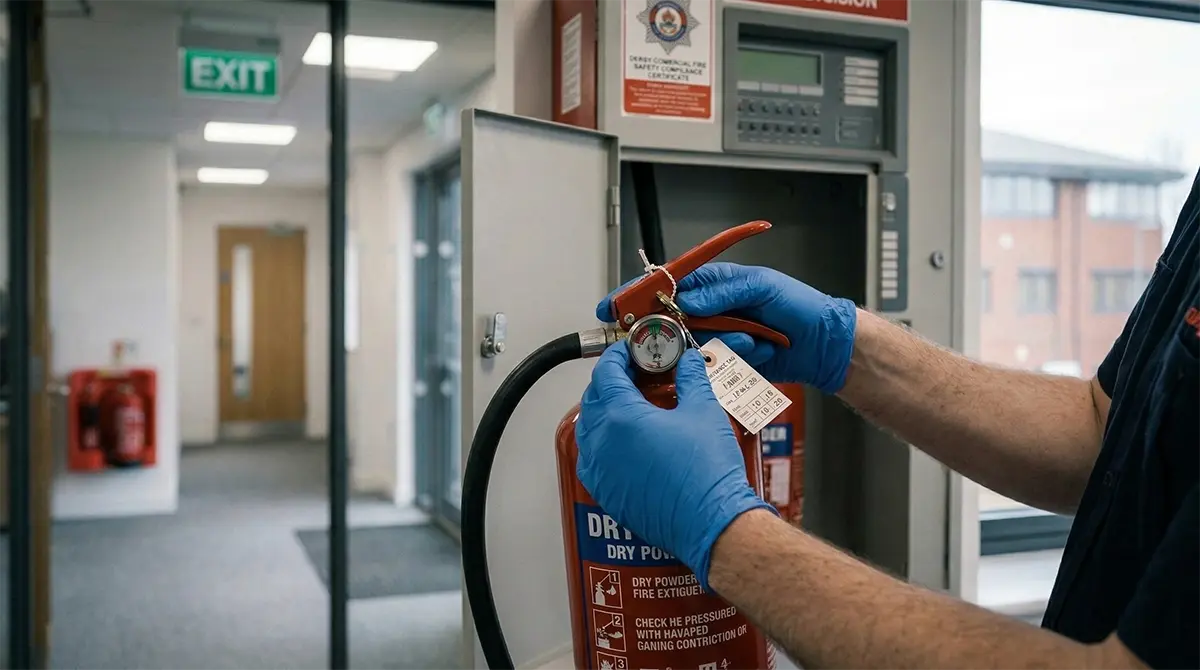
If your premises has gone longer than six months without a professional service visit, or if your team is relying on weekly call-point tests as a substitute for proper maintenance, now is the time to put that right. Commercial fire alarm maintenance Derby businesses need is about compliance, but it is also about avoiding preventable faults, reducing false alarms and keeping people protected when the system is needed most.
AKSA Security can help with planned maintenance, fault diagnosis, repairs and ongoing support for commercial premises across Derby and Derbyshire. If your fire alarm system is overdue a service, showing faults, or causing repeated unwanted activations, arrange a maintenance visit and get the system checked properly. You can contact AKSA Security on 07881 457719 or 0800 233 5811.

Author: Adrian Sienkiewicz, Fire And Security Project Manager at AKSA Security
Adrian started his career as an IT Support Engineer but after a while, he moved into the security industry using his experience with IT systems. He started his first security job as a Fire and Security Engineer at ALX Security and then continued as a Fire and Security Project Manager at Bull Security.
During his career, he has worked for SECURIFIX, LASER BEAM and ZICAM GROUP as a Security Engineer, Technical Support and Operations Manager. Adrian has worked on security projects for companies such as DHL, Selco Building Warehouse and Eddie Stobart, installing anti-burglary systems, industrial surveillance and access control systems. He is working on a partnership basis with companies such as Avigilon, Motorola, Honeywell, Texecom, Hikvision, Hanwha, Dahua, Commtel, Paxton and BFT.
Adrian is a certified National Security Industry auditor.